
Most technology companies spend years trying to be taken seriously outside their industry. They commission ethics boards, publish responsibility reports, hire philosophers. The validation is rarely convincing, because the incentives are too obvious.
Anthropic didn't need to do any of that last week. The Vatican did it for them.
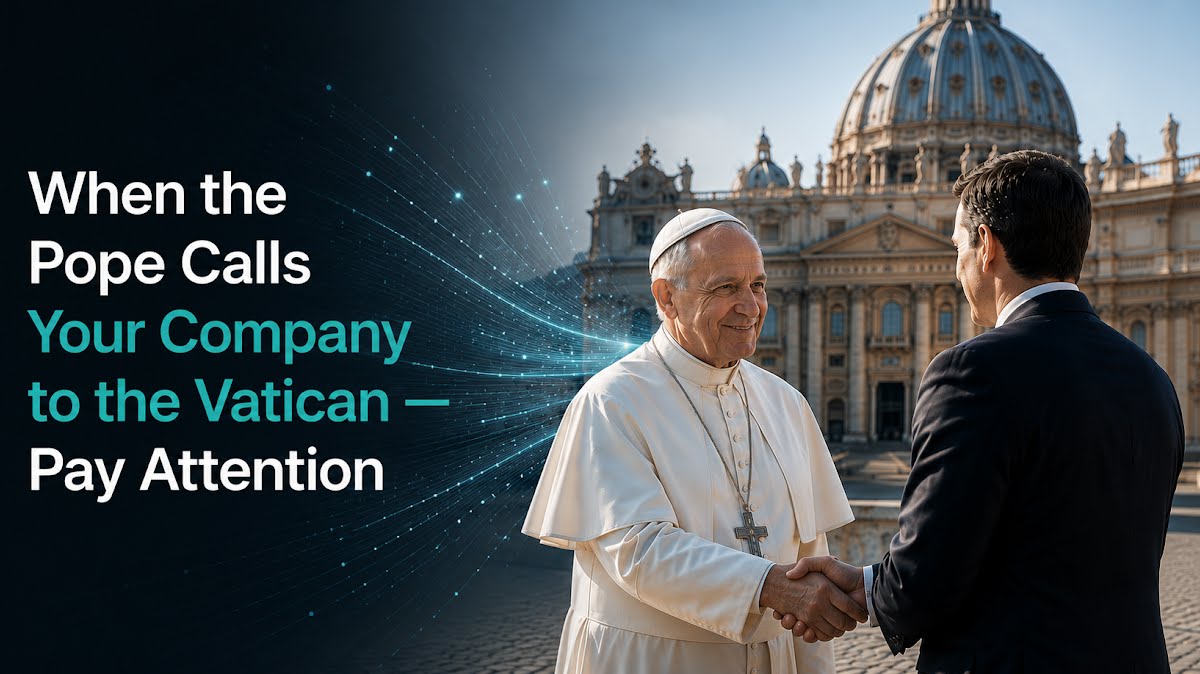
When Pope Leo XIV launched Magnifica Humanitas — his sweeping first encyclical on artificial intelligence — he chose to include Anthropic co-founder Christopher Olah as one of the featured speakers at the Vatican presentation. The Catholic Church has 1.4 billion members. It has been navigating questions of human dignity, the ethics of power, and the moral limits of technology for two thousand years. It does not lend its platform lightly.
An encyclical is one of the most authoritative teaching documents a pope can issue — addressed to the entire Catholic Church and, on matters of global concern, to the world. It is not a press release. It is a considered articulation of the Church's position on a subject it has decided requires the full weight of its moral authority.
Magnifica Humanitas — "Magnificent Humanity" — is the first encyclical in history dedicated entirely to artificial intelligence.
What the Pope actually said
Pope Leo XIV did not offer a comfortable endorsement of the AI industry. He called for artificial intelligence to be "disarmed, freed from logics that turn it into an instrument of domination, exclusion and death." He declared that entrusting irreversible, lethal decisions to AI systems is "not permissible." He warned that "a more moral AI is not enough if that morality is determined by a few."
He was, in the most precise sense, criticizing the concentration of AI power in the hands of a small number of private companies — including Anthropic — while simultaneously inviting one of those companies to stand at the podium with him.
That is not contradiction. That is exactly how the most consequential conversations about technology need to be structured: with the most powerful developers in the room, held accountable by voices they cannot dismiss, cannot acquire, and cannot ignore.
Why Anthropic was in that room
The Vatican's decision to include Anthropic was not random. It reflects a decade-long effort by the Catholic Church to engage Silicon Valley in direct dialogue — and a specific recognition that Anthropic occupies an unusual position in the AI landscape.
Anthropic is simultaneously one of the world's most commercially valuable AI companies, currently fighting the Trump administration in court after refusing to allow unrestricted military use of its technology, and a company whose founding mission is explicitly about building AI that is safe, trustworthy, and aligned with human values. It is, in short, the AI company whose stated values are closest to the ethical framework the Pope was articulating.
Chris Olah's remarks at the Vatican reinforced this. He acknowledged that computer scientists alone cannot determine the ethical boundaries of AI — that developers are themselves subject to the same incentives of ambition, competition, and financial pressure that the Pope was warning about.
"We need more of the world — religious communities, civil society, scholars, governments, and indeed all people of good will — to do what His Holiness has done here: to take this seriously, to look closely, and to push events in a better direction."
— Christopher Olah, co-founder, Anthropic · Vatican, May 25, 2026
What this means for the Gulf
The Gulf is not a secular market. The UAE, Saudi Arabia, Qatar, Bahrain — these are societies where values, religion, and governance are deeply intertwined. When a technology company is invited to stand with the Pope at the Vatican, and when that company's co-founder publicly calls for external moral accountability in AI development, that carries a different kind of weight in this region than a corporate responsibility report ever could.
Anthropic now carries a moral credential that no other frontier AI company has. OpenAI was not at the Vatican. Google was not at the Vatican. Microsoft was not at the Vatican. Anthropic was — and not as a spectator. As a participant in the most serious global conversation about the ethical limits of the technology it builds.
For governments and sovereign institutions in the Gulf that are navigating exactly these questions — how to deploy powerful AI without compromising human dignity, national identity, or social cohesion — that distinction matters enormously. These are not markets that separate commercial value from moral framework. They are markets where the two are inseparable.
The argument this makes for a different kind of presence
At Qlabs Intelligence, we have argued consistently that the Gulf requires more than a sales function from its technology partners. It requires seniority, trust, and a demonstrated alignment with the values of the institutions it seeks to serve.
The Vatican encyclical gives Anthropic something rare: a third-party validation of its moral seriousness from the most credible non-governmental moral authority in the world. That is an asset in every market. In the Gulf, it is a strategic differentiator.
The question is whether Anthropic will be present in the region with the right seniority and relationships to deploy it.
[2] USCCB — Pope Leo urges world to "disarm" AI, Chris Olah remarks: usccb.org
[3] TIME — Pope Leo XIV warns of dangers of AI in first encyclical: time.com
[4] National Catholic Reporter — Pope Leo calls to "disarm" AI: ncronline.org
[5] OSV News — Pope Leo's encyclical on AI: osvnews.com